Poster Session 2 · Wednesday, December 3, 2025 4:30 PM → 7:30 PM
#809
Revisiting 1-peer exponential graph for enhancing decentralized learning efficiency
Abstract
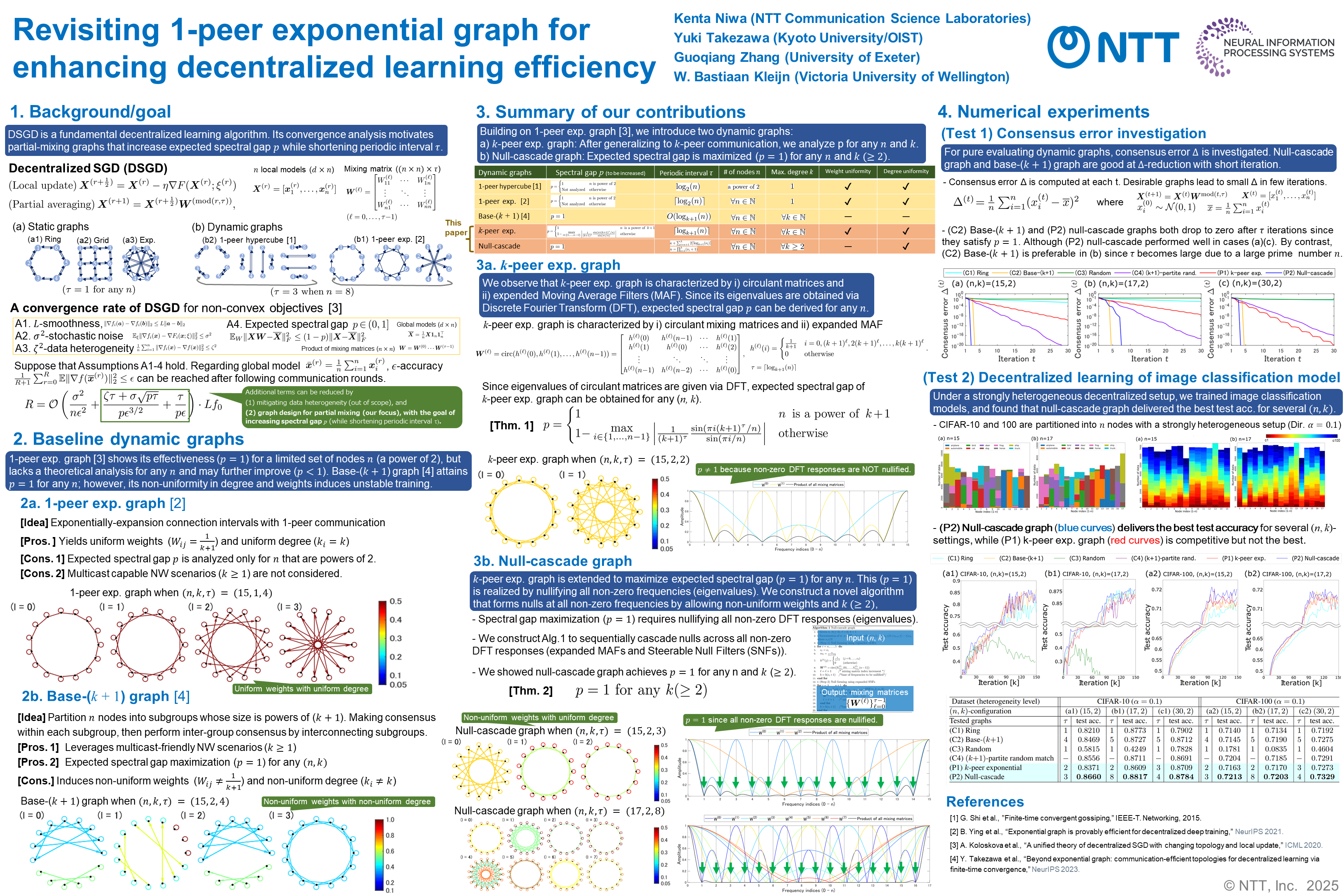
For communication-efficient decentralized learning, it is essential to employ dynamic graphs designed to improve the expected spectral gap by reducing deviations from global averaging. The -peer exponential graph demonstrates its finite-time convergence property--achieved by maximizing the expected spectral gap--but only when the number of nodes is a power of two. However, its efficiency across any and the commutativity of mixing matrices remain unexplored.
We delve into the principles underlying the -peer exponential graph to explain its efficiency across any and leverage them to develop new dynamic graphs. We propose two new dynamic graphs: the -peer exponential graph and the null-cascade graph.
Notably, the null-cascade graph achieves finite-time convergence for any while ensuring commutativity. Our experiments confirm the effectiveness of these new graphs, particularly the null-cascade graph, in most test settings.