Poster Session 3 · Thursday, December 4, 2025 11:00 AM → 2:00 PM
#2305
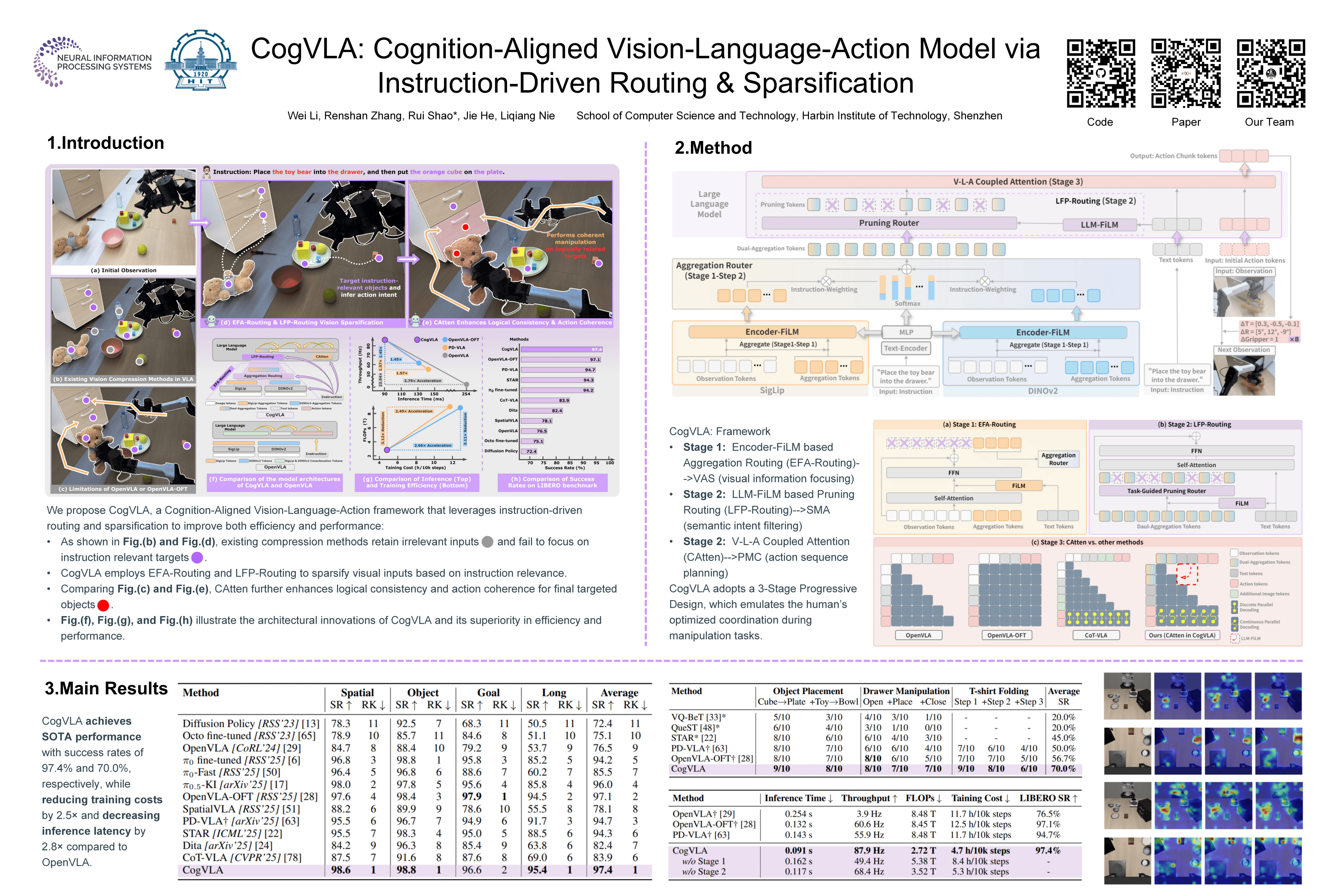
CogVLA: Cognition-Aligned Vision-Language-Action Models via Instruction-Driven Routing & Sparsification
Abstract
Recent Vision-Language-Action (VLA) models built on pre-trained Vision-Language Models (VLMs) require extensive post-training, resulting in high computational overhead that limits scalability and deployment. Existing sparsification strategies—such as Mixture-of-Depths, layer skipping, and early exit—fall short by neglecting the semantic coupling across vision-language-action modalities, and focusing narrowly on intra-LLM computation while overlooking end-to-end coherence from perception to control.
To address these challenges, we propose CogVLA, a Cognition-Aligned Vision-Language-Action framework that leverages instruction-driven routing and sparsification to improve both efficiency and performance. CogVLA draws inspiration from human multimodal coordination and introduces a 3-stage progressive architecture.
- Encoder-FiLM based Aggregation Routing (EFA-Routing) injects instruction information into the vision encoder to selectively aggregate and compress dual-stream visual tokens, forming a instruction-aware latent representation.
- Building upon this compact visual encoding, LLM-FiLM based Pruning Routing (LFP-Routing) introduces action intent into the language model by pruning instruction-irrelevant visually grounded tokens, thereby achieving token-level sparsity.
- To ensure that compressed perception inputs can still support accurate and coherent action generation, we introduce V‑L‑A Coupled Attention (CAtten), which combines causal vision-language attention with bidirectional action parallel decoding.
Extensive experiments on the LIBERO benchmark and real-world robotic tasks demonstrate that CogVLA achieves state-of-the-art performance with success rates of 97.4% and 70.0%, respectively, while reducing training costs by 2.5 and decreasing inference latency by 2.8 compared to OpenVLA.