Poster Session 6 · Friday, December 5, 2025 4:30 PM → 7:30 PM
#1005
Homogeneous Algorithms Can Reduce Competition in Personalized Pricing
Abstract
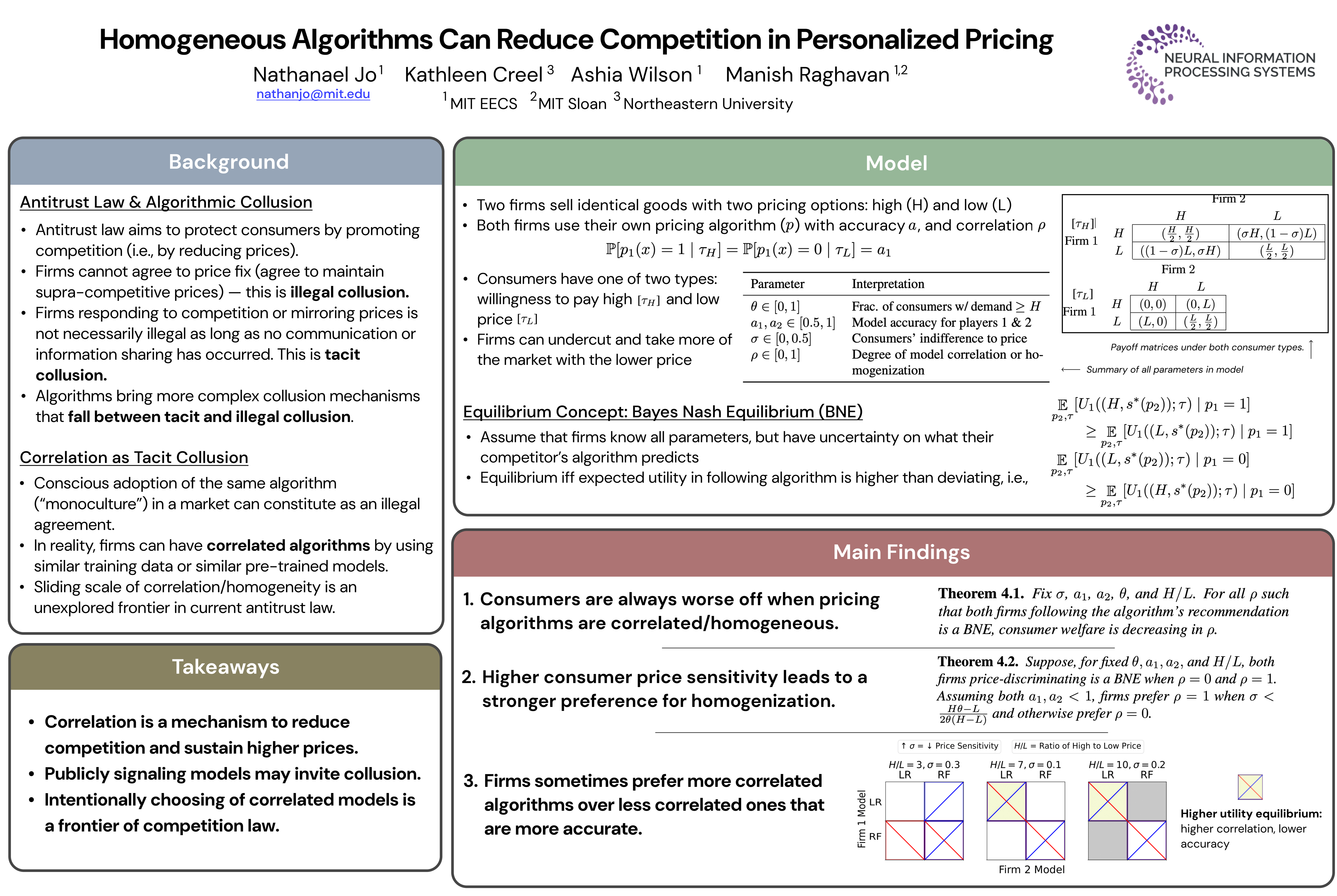
Firms' algorithm development practices are often homogeneous Whether firms train algorithms on similar data or rely on similar pre-trained models, the result is correlated predictions.
In the context of personalized pricing, correlated algorithms can be viewed as a means to collude among competing firms, but whether or not this conduct is legal depends on the mechanisms of achieving collusion.
We investigate the precise mechanisms through a formal game-theoretic model. Indeed, we find that
- higher correlation diminishes consumer welfare
- as consumers become more price sensitive, firms are increasingly incentivized to compromise on the accuracy of their predictions in exchange for coordination.
We demonstrate our theoretical results in a stylized empirical study where two firms compete using personalized pricing algorithms. Our results demonstrate a new mechanism for achieving collusion through correlation, which allows us to analyze its legal implications. Correlation through algorithms is a new frontier of anti-competitive behavior that is largely unconsidered by US antitrust law.