Poster Session 4 · Thursday, December 4, 2025 4:30 PM → 7:30 PM
#3417
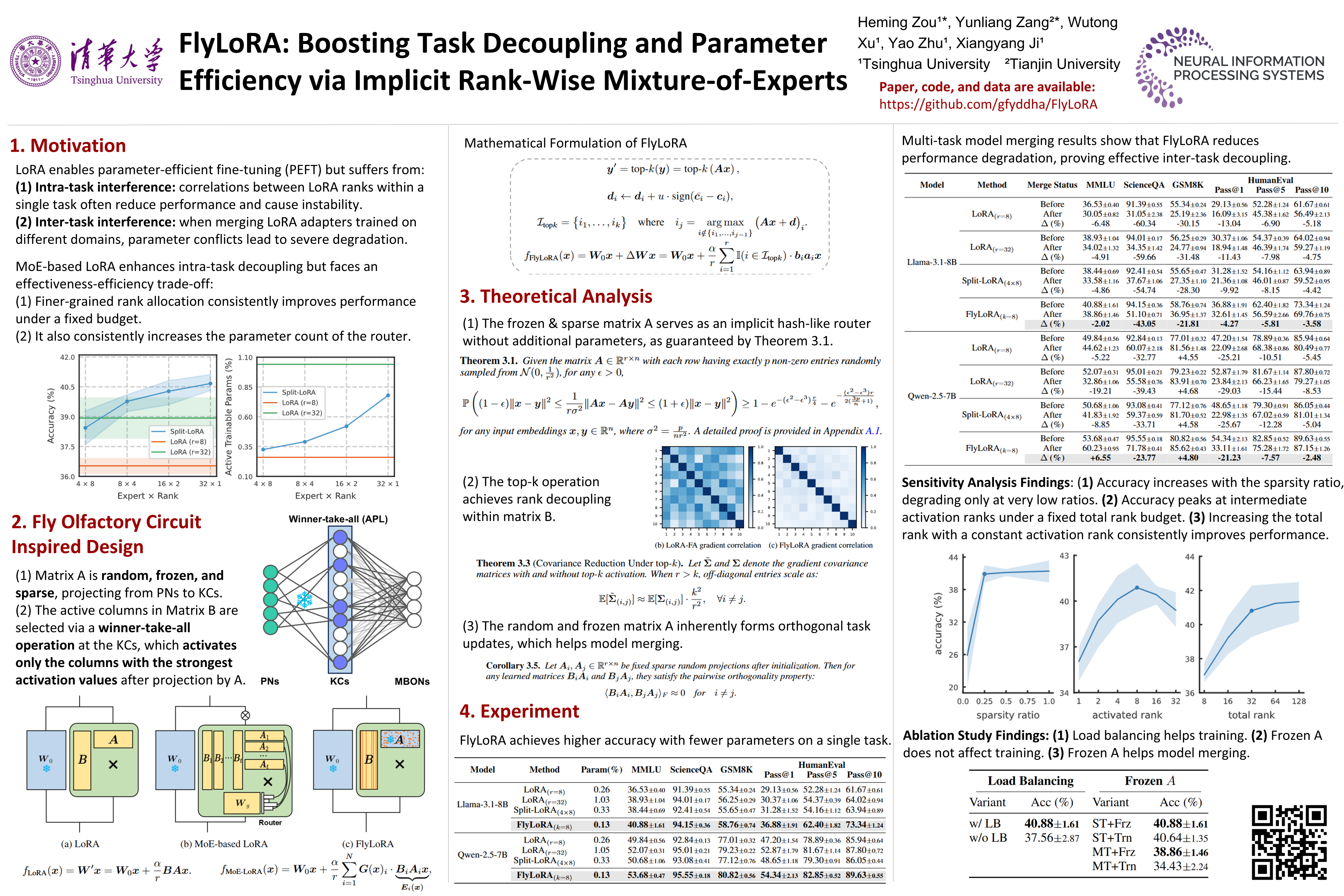
FlyLoRA: Boosting Task Decoupling and Parameter Efficiency via Implicit Rank-Wise Mixture-of-Experts
Abstract
Low-Rank Adaptation (LoRA) is a widely used parameter-efficient fine-tuning method for foundation models, but it suffers from parameter interference, resulting in suboptimal performance. Although Mixture-of-Experts (MoE)-based LoRA variants show promise in mitigating intra-task correlations in single-task instruction tuning, they introduce additional router parameters and remain ineffective in multi-task model merging where inter-task interference arises.
Inspired by the fly olfactory circuit, we propose FlyLoRA, an implicit MoE-based LoRA variant that introduces:
- rank-wise expert activation in the up-projection matrix, and
- an implicit router that unifies expert routing and down-projection, where a frozen sparse random projection matrix replaces the traditional dense trainable version.
This design resolves the trade-off between intra-task decorrelation and computational efficiency by eliminating the need for an explicit router, while inherently mitigating inter-task interference due to the orthogonality property of random matrices.
Extensive experiments across four domains---general knowledge understanding, scientific question answering, mathematical reasoning, and code generation---demonstrate consistent performance improvements over existing methods. Beyond empirical gains, FlyLoRA highlights how biological structures can inspire innovations in AI technologies. Code is available at
https://github.com/gfyddha/FlyLoRA.