Poster Session 5 · Friday, December 5, 2025 11:00 AM → 2:00 PM
#2905
On Hierarchies of Fairness Notions in Cake Cutting: From Proportionality to Super Envy-Freeness
Abstract
We consider the classic cake-cutting problem of producing fair allocations for agents, in the Robertson–Webb query model. In this model, it is known that:
- proportional allocations can be computed using queries, and this is optimal for deterministic protocols;
- envy-free allocations (a subset of proportional allocations) can be computed using queries, and the best known lower bound is ;
- perfect allocations (a subset of envy-free allocations) cannot be computed using a bounded (in ) number of queries.
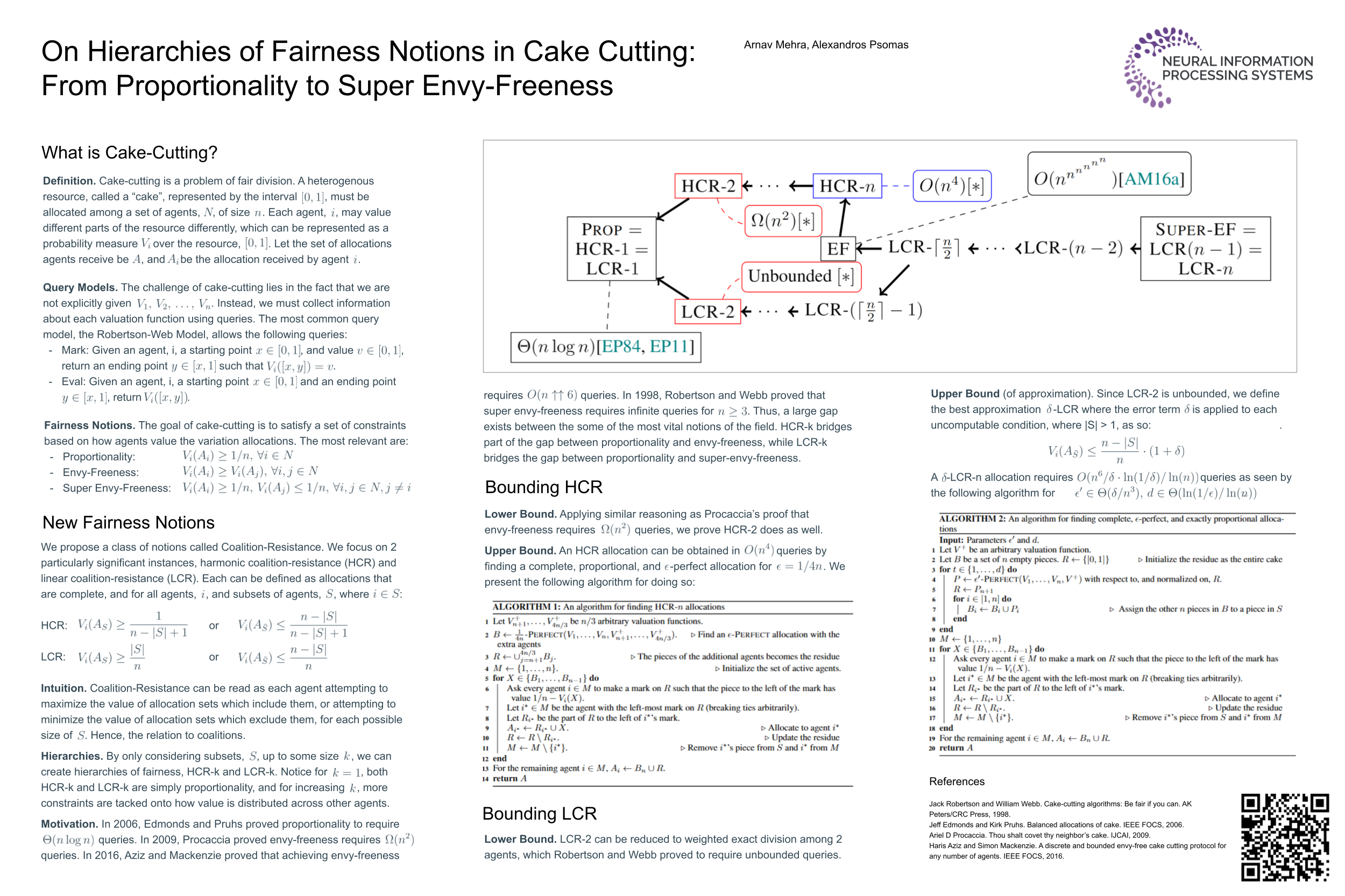
In this work, we introduce two hierarchies of new fairness notions: newnotioninverse (newnotioninverseabbrev) and newnotionlinear (newnotionlinearabbrev). An allocation is newnotioninverseabbrev- if the allocation is complete and, for any subset of agents of size at most , every agent believes the value of all pieces allocated to agents in to be at least , making the union of all pieces allocated to agents not in at most ; for newnotionlinearabbrev- allocations, these bounds become and , respectively. Intuitively, these notions of fairness ask that, for every agent , the collective value (from the perspective of agent ) that a group of agents receives is limited. If the group includes , its value is lower-bounded, and if the group excludes , it is upper-bounded, thus providing the agent some protection against the formation of coalitions.
Our hierarchies bridge the gap between proportionality, envy-freeness, and super envy-freeness. newnotioninverseabbrev- and newnotionlinearabbrev- coincide with proportionality for . For all , newnotioninverseabbrev- allocations are a superset of envy-free allocations (i.e., easier to find). On the other hand, for , newnotionlinearabbrev- allocations are incomparable to envy-free allocations. For , newnotionlinearabbrev- allocations are a subset of envy-free allocations (i.e., harder to find), while newnotionlinearabbrev- coincides with super envy-freeness: the value of each agent for their piece is at least , and their value for the piece allocated to any other agent is at most .
We prove that newnotioninverseabbrev- allocations can be computed using queries in the Robertson–Webb model. On the flip side, finding newnotioninverseabbrev- (and therefore all newnotioninverseabbrev- for ) allocations requires queries, while newnotionlinearabbrev- (and therefore all newnotionlinearabbrev- for ) allocations cannot be computed using a bounded (in ) number of queries. Our results reveal that envy-free allocations occupy a curious middle ground, between a computationally impossible notion of fairness, newnotionlinearabbrev-, and a computationally "easy" notion, newnotioninverseabbrev-.