Poster Session 6 · Friday, December 5, 2025 4:30 PM → 7:30 PM
#813
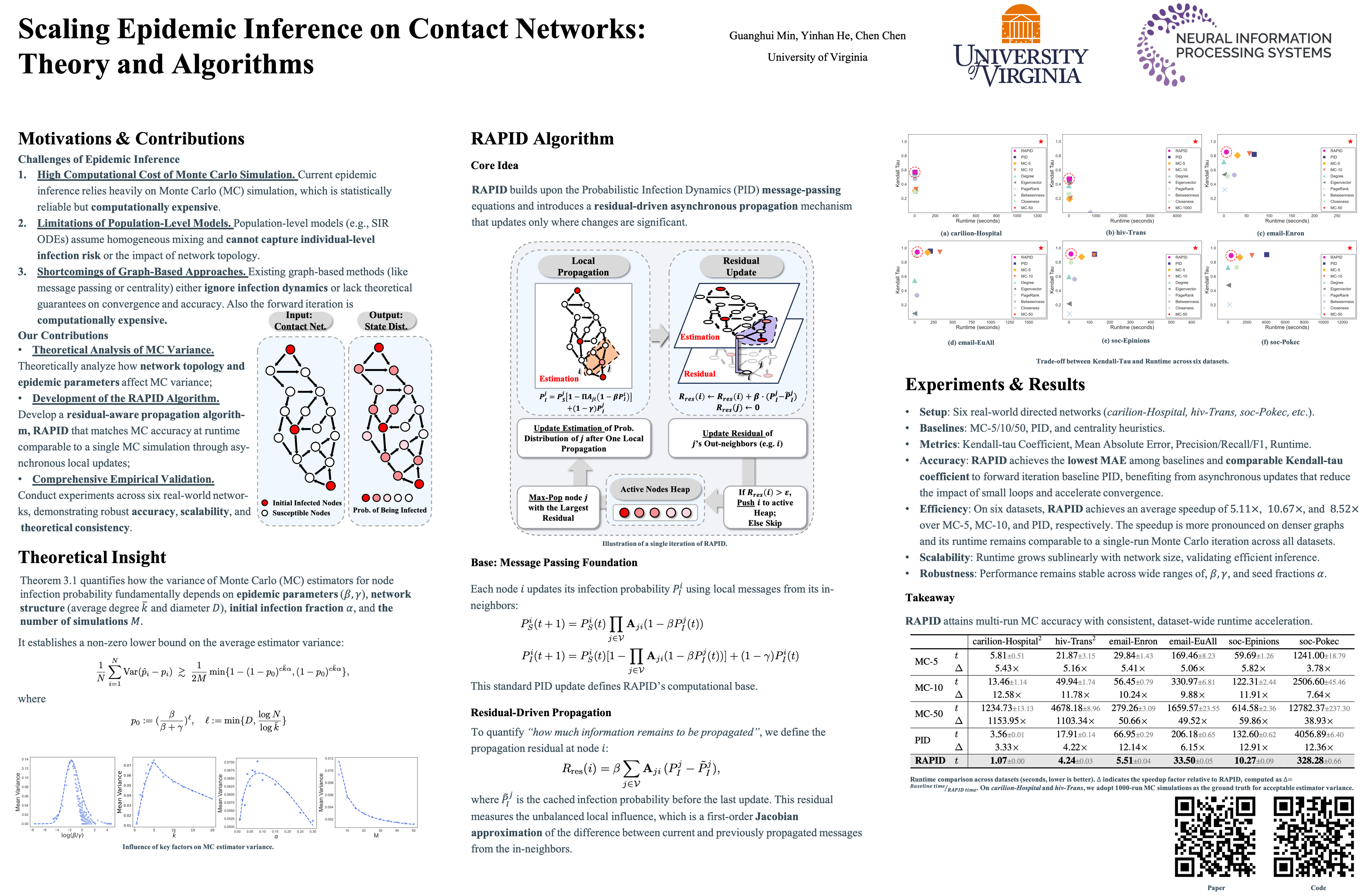
Scaling Epidemic Inference on Contact Networks: Theory and Algorithms
Abstract
Computational epidemiology is crucial in understanding and controlling infectious diseases, as highlighted by large-scale outbreaks such as COVID-19. Given the inherent uncertainty and variability of disease spread, Monte Carlo (MC) simulations are widely used to predict infection peaks, estimate reproduction numbers, and evaluate the impact of non-pharmaceutical interventions (NPIs). While effective, MC-based methods require numerous runs to achieve statistically reliable estimates and variance, which suffer from high computational costs.
In this work, we present a unified theoretical framework for analyzing disease spread dynamics on both directed and undirected contact networks, and propose an algorithm, RAPID, that significantly improves computational efficiency. Our contributions are threefold.
- First, we derive an asymptotic variance lower bound for MC estimates and identify the key factors influencing estimation variance.
- Second, we provide a theoretical analysis of the probabilistic disease spread process using linear approximations and derive the convergence conditions under non-reinfection epidemic models.
- Finally, we conduct extensive experiments on six real-world datasets, demonstrating our method's effectiveness and robustness in estimating the nodes' final state distribution.
Specifically, our proposed method consistently produces accurate estimates aligned with results from a large number of MC simulations, while maintaining a runtime comparable to a single MC simulation. Our code and datasets are available at https://github.com/GuanghuiMin/RAPID.