Poster Session 1 · Wednesday, December 3, 2025 11:00 AM → 2:00 PM
#709
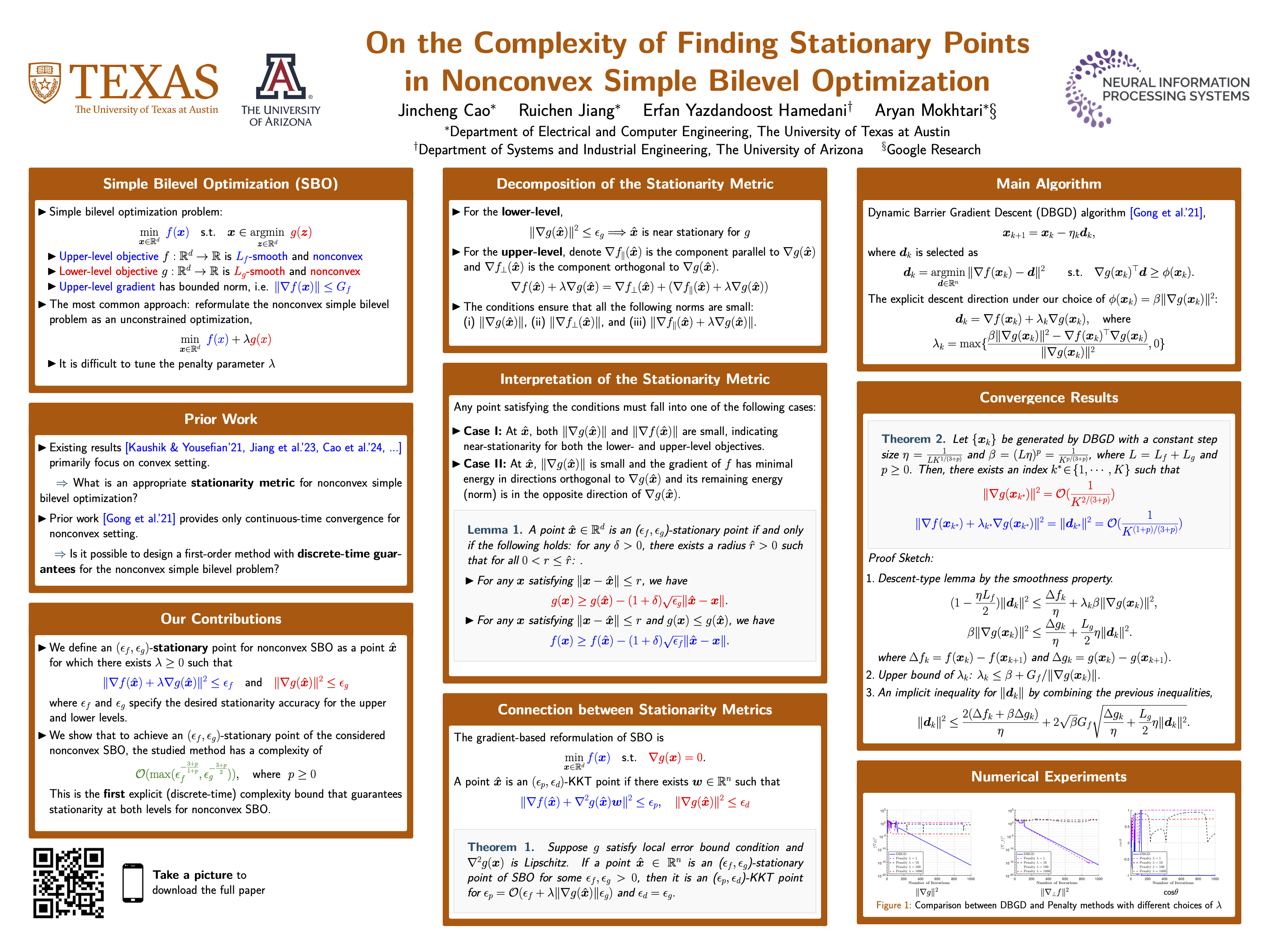
On the Complexity of Finding Stationary Points in Nonconvex Simple Bilevel Optimization
Abstract
In this paper, we study the problem of solving a simple bilevel optimization problem, where the upper-level objective is minimized over the solution set of the lower-level problem. We focus on the general setting in which both the upper- and lower-level objectives are smooth but potentially nonconvex. Due to the absence of additional structural assumptions for the lower-level objective—such as convexity or the Polyak–Łojasiewicz (PL) condition—guaranteeing global optimality is generally intractable.
Instead, we introduce a suitable notion of stationarity for this class of problems and aim to design a first-order algorithm that finds such stationary points in polynomial time. Intuitively, stationarity in this setting means the upper-level objective cannot be substantially improved locally without causing a larger deterioration in the lower-level objective. To this end, we show that a simple and implementable variant of the dynamic barrier gradient descent (DBGD) framework can effectively solve the considered nonconvex simple bilevel problems up to stationarity.
Specifically, to reach an -stationary point—where and denote the target stationarity accuracies for the upper- and lower-level objectives, respectively—the considered method achieves a complexity of , where is an arbitrary constant balancing the terms. To the best of our knowledge, this is the first complexity result for a discrete-time algorithm that guarantees joint stationarity for both levels in general nonconvex simple bilevel problems.